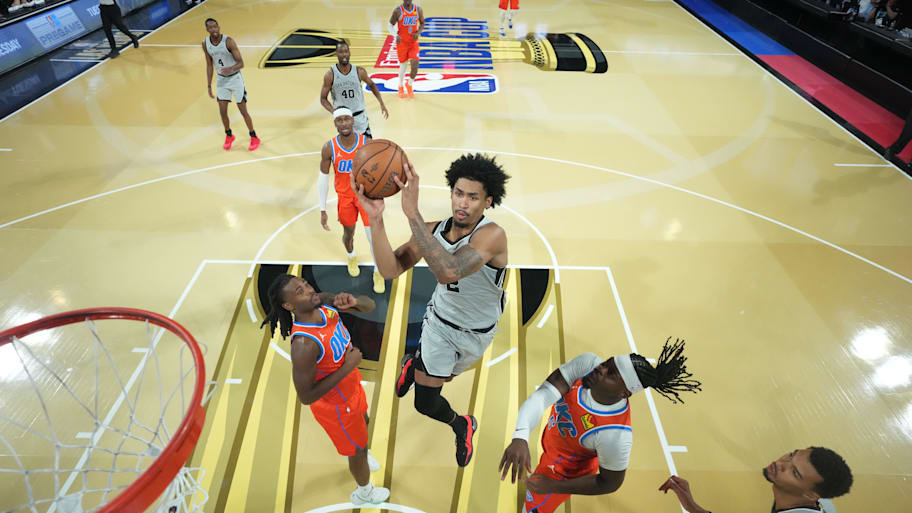
Last week, the NBA issued an unusual press release. In response to a story in The Athletic connecting the league’s NBA Cup schedule to the rash of early-season soft tissue injuries—a story that was also published in print by its parent company, The New York Times—the league fired off a rare public rebuke. The article’s conclusions, the NBA said, are “not supported by data.” The league pointed out that the number of games played this season is roughly the same as last season, while injuries to star players were down by 25%. Any connections between games played and injuries, an NBA spokesman wrote, were “patently false.”
The story, clearly, struck a nerve. Well, a couple, really. For years, league officials have been sensitive to criticism of scheduling. The NBA has taken steps to reduce player workloads—slashing the number of back-to-backs, reducing miles traveled, introducing so-called “baseball series” where two teams play in the same city twice, etc.—but cramming 82 games into 174 days is grueling, more so with the pace of play increasing to record levels. The only way to really address the issue is to slash the number of games. And we know how that conversation ends.
Then there is the criticism of the Cup. The NBA is quite proud of its creation, part of a yearslong effort to increase interest in the regular season while creating another revenue stream. The success of the play-in tournament emboldened league officials to try a European-style in-season tourney, one complete with unique floors and a Finals-like (or really Final Four–like) finish. And in their minds, it’s working.
U.S. viewership of Cup games in group play topped 40 million, per league data, up a whopping 90% from last season. The caveat to these numbers, of course, is that the NBA’s broadcast agreements are very different from last season, with another over-the-air network (NBC) on board, along with the Amazon Prime Video fire hose. Still, the stats are solid: On regional networks, the household share—defined as the percentage of households watching television at a specific time that are tuned into a particular show—is up 6% year over year—and 6% higher than non-Cup games this season. Internationally, viewership has grown by 10%.
Players have largely embraced it. The Cup doesn’t have the cache of a Larry O’Brien Trophy—“It’s not going to be a super significant step,” said Spurs center Victor Wembanyama when asked about winning the Cup, “but still a significant one,”—but it’s not supposed to. The idea is to give a fall schedule that exists in the shadow of college football and the NFL a little more juice. “Stuff is a little elevated,” said Magic forward Paolo Banchero. “Teams play a little harder.” Here again, the NBA provides data: 63.3% of Cup games have been “clutch” games, six points higher than non-Cup contests. Some 20% of Cup games have been decided by three points or fewer. In non-Cup games, it’s 15.7%.
“I just know that the Cup has been doing really well with the fans,” said Knicks forward Karl-Anthony Towns. “They appreciate it, and we appreciate playing in these games. As long as the fans continue to be interested, we’re going to continue to give them the best product.”
Cup games offer increased exposure. The NBA clears the field for the Cup Final Four. Tuesday’s Spurs-Knicks championship game is the only one on the calendar. And while there isn’t a Finals-like media presence in Las Vegas, the league gives it a Finals-like rollout, complete with a full slate of national interviews and press availabilities. Teams see value in that. “These guys are feeling and seeing what it’s like, with all the media attention,” said Magic coach Jamahl Mosley. “The different focus that will try to distract you.”
The money doesn’t hurt, either. “[Jaylin Williams] reminds us the exact dollar amount every single day of what it would be to win,” said Thunder guard Jalen Williams. Semifinal teams earn $106,000 per player. The Knicks and Spurs, who will compete in the championship game, will earn at least $212,000. Players from the winning team will collect $530,000 apiece. That won’t mean much to, say, Towns or De’Aaron Fox, but for two-way players or veterans on more modest salaries, it’s significant.
Even the guys that don’t need it have some ideas for how to spend it. Spurs wing Keldon Johnson wants to add a llama to his growing farm outside of San Antonio. Towns said he would donate it to a charity in the Dominican Republic. Knicks forward Josh Hart said he’d buy a watch to replace one that was stolen when his hotel room was robbed in September.
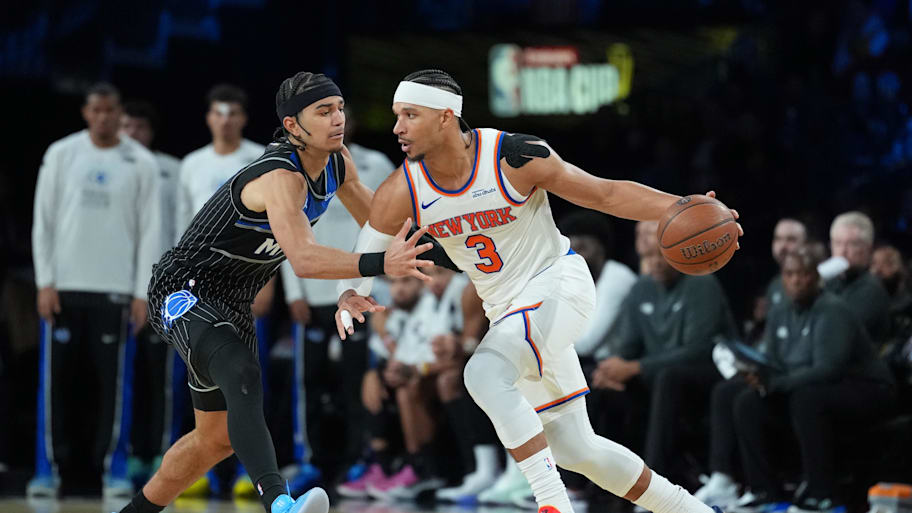
Ultimately, a league argument often boils down to this: It can’t hurt. The longstanding joke among casual NBA fans is that the season begins on Christmas. Ratings for regular-season games are often beaten by reruns. If the cost is minimal—and if you believe the NBA, the cost is nothing—why not increase the value in games fans have been conditioned not to care about?
Besides, the NBA isn’t done experimenting with the Cup. Beginning next season, the semifinals will be played at the home arena of the higher-seeded team in each conference. There’s even been some chatter about moving the championship game away from a neutral site, though that may have more to do with the league’s growing concern with the cratering Las Vegas economy.
There are legitimate arguments to be made about the season’s density. Opening training camps earlier and starting the season later would create more of a needed ramp-up. And soft tissue injuries—and the terror teams feel when a player shows even a sign of a soft tissue injury—are problems the league must address. Killing the Cup, though, is too simplistic a solution.
Especially as it continues to win converts. Knicks coach Mike Brown was anti-Cup when it was introduced in 2023. “I was like, oh, man, for what?” said Brown. “In the middle of the season? We are trying to do this and that and practice and blah, blah, blah.” After experiencing a true Cup run, Brown’s opinion has shifted.
“Everybody naturally fights change or wants to say something against change,” said Brown. “This is a really, really neat thing. I said this even before I even got here, I thought it was neat, and it’s a fantastic experience for everybody. You really applaud how the NBA has tried to continue to find ways to make this more meaningful across the board. It’s a pleasure to be here.”
More NBA from Sports Illustrated
Listen to SI’s NBA podcast, Open Floor, below or on Apple and Spotify. Watch the show on SI’s YouTube channel.
This article was originally published on www.si.com as Why the NBA Is Defending the In-Season Tournament Amid Criticism of Early Injuries.