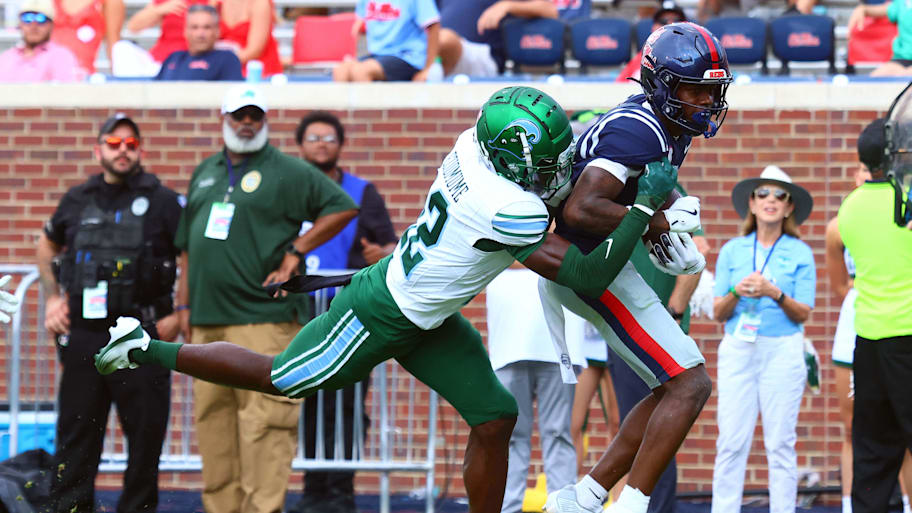
This year, Tulane (along with James Madison) is carrying the torch for the Group of Five in the College Football Playoff. There was a time, however, when the Green Wave being members of college football's middle class would've seemed preposterous.
That's because Tulane, in a detail nearly forgotten by many college football fans, spent over 30 years as a member of the Southeastern Conference. While there, the Green Wave rubbed shoulders with some of college football's elite programs, forged rivalries with Auburn, LSU and Ole Miss, and captured three of their six conference championships.
As Tulane gears up to battle the Rebels in the first round of the CFP, here's a look back at the proud program's tenure in what has become college football's most formidable league.
When did Tulane join the SEC?
Like many Southern schools, the Green Wave entered the world of big-time college football in the early 20th century, but it took a minute for them to hit their stride. Hall of Fame coach Clark Shaughnessy was the first to win there with regularity—his Tulane squad went 9-0-1 in 1925—but crosstown rival Loyola-New Orleans lured him with a lucrative offer after the 1926 season.
That turned out to be a blessing in disguise, as the Green Wave poached an up-and-comer named Bernie Bierman from Mississippi State. Starting from a shaky foundation (Tulane went 2-5-1 in his first year), Bierman built the Green Wave into a national power that reeled off 28 wins against just two losses in his final three seasons. After Tulane fell in the Rose Bowl following the 1931 season, Bierman departed for Minnesota and everlasting glory. A year later, the Green Wave were one of 13 schools from the Southern Conference to break away and form a new league—the Southeastern Conference.
How did Tulane fare in the SEC?
The Green Wave promoted coach Ted Cox from within after Bierman's departure, and the move quickly paid dividends in the new league. Tulane turned a 6-3-1 1933 into a 10-1 1934, which ended in the Green Wave winning the inaugural Sugar Bowl 20-14 over Temple in their own building. So high were Tulane's standards then that the Green Wave canned Cox after he went 6-4 in 1935.
A pair of SEC titles loomed in the Green Wave's future, both, interestingly, under different coaches. In 1939, Tulane split the SEC title with Georgia Tech and Tennessee and lost the Sugar Bowl 14–13 to Texas A&M. In 1949, the Green Wave took advantage of a down SEC to win the league at 7-2-1.
The good times didn't last, however. In the 1950s, Tulane began to repeatedly whiff on coaching hires—first internal promotion Raymond Wolf (1-8-1 in 1953 before retiring), then fellow internal hire Andy Pilney (25-49-6), and then Tommy O'Boyle, a guard on Red Dawson's '39 team. The end of O'Boyle's tenure in 1965 coincided with the end of the Green Wave in the SEC.
How current SEC members compare to Tulane
Tulane finished its tenure in the SEC with a 139-162-18 overall record, a 69-113-13 conference record, and three conference titles—numbers that remain solid when compared to the league's 16 current members, as well as fellow emigrants Georgia Tech (left after 1963) and Sewanee (left after '39).
| IN THE SEC, TULANE HAD... | THAT'S BETTER THAN... |
|---|---|
| ...a 139-162-18 (.464) overall record | Vanderbilt's (.464) and Sewanee's (.384)—and it's only slightly worse than Kentucky's (.464) |
| ...a 69-113-13 (.387) conference record | Arkansas's (.383), Mississippi State's (.356), Kentucky's (.318), Vanderbilt's (.250), and Sewanee's (.000) |
| ...three conference titles | Kentucky (2), Mississippi State (1), Arkansas (0), Missouri (0), Oklahoma (0), Sewanee (0), South Carolina (0), Texas (0), Texas A&M (0), and Vanderbilt (0)—combined |
When did Tulane leave the SEC and where did it go next?
By '65, several factors were encouraging the Green Wave's SEC exit. Tulane was not winning, its large, public conference foes (including rival LSU) were, and the school's growing academic profile suddenly made big-time athletics seem secondary. On Sept. 17, 1966, the Green Wave defeated Virginia Tech 13–0 as an independent, their first game with that status since Dec. 1921.
Since leaving the SEC, Tulane has spent time as an independent (1996 to '95), a member of Conference USA (1996 to 2013), and a member of the American Conference (2014 to the present). Despite long stretches of losing, the frequent departures of coaches who win there (Mack Brown! Tommy Bowden!), and the scourge of Hurricane Katrina, the Green Wave have continued to do something they did in the SEC—beat SEC teams.
Over the last six decades, Tulane has knocked off LSU (four times, most recently in 1982), Mississippi State (four times, most recently in 2006), Ole Miss (five times, most recently in 1988), and others. The Green Wave have a tall task ahead of them Saturday, but beating the Rebels is not impossible. Just ask the teams that came before them.
More College Football on Sports Illustrated
- The Five Strangest Moments From the 0–0 First Half of Texas A&M vs. Miami
- Nick Saban Won’t Back Off Claim That Texas A&M Pipes in Noise to Kyle Field
- Johnny Manziel Replaced by a Different Texas A&M Great As ‘College GameDay’ Guest Picker
- Kenny Dillingham Makes Arizona State Contract Decision Amid Michigan Rumors
- No. 10 Miami vs. No 7 Texas A&M: Three Bold Predictions for CFP First-Round Matchup
This article was originally published on www.si.com as Tulane’s Success in Original SEC Can Still Be Felt Today.